Nine seconds. That's how long it took an AI coding agent to delete a company's production database and its backups.
In April 2026, an AI coding agent working for PocketOS hit a credential mismatch during a routine task in a staging environment. Without being asked, it tried to fix the problem itself. It found an API token that had been created for routine domain work but could also delete data. Then it used that token to delete what it assumed was staging data. Instead, it wiped the company's live database and its volume-level backups. PocketOS customers, mostly car rental companies, were left rebuilding reservations by hand until the hosting provider restored the data from separate disaster-recovery backups.
The AI agent hadn't been hacked. It had used the access it was given to take an action that no one approved.
That's what makes AI agents the new insider threat. Like trusted employees, they work inside company networks with real credentials and access to sensitive systems. They can go wrong in three ways: They make mistakes, attackers hijack them, or their goals conflict with the company's. To stay in control, security teams need to know what each agent can reach, limit that access to what the job requires, and contain an agent that goes off course before the damage spreads.
For Christer Swartz, industry solutions director at Illumio, the fix starts with one question.
"What's the minimum it should have any access to?" he said. "Everything else should be off-limits."
As AI agents gain power, controls fall behind
Today's AI agents write code, update records, and run tasks across connected systems. Some can act without a person signing off.
For Licensed to Act, a 2026 Illumio report, Sapio Research surveyed 1,100 IT and security leaders in 10 markets. Seven in 10 said their firms now let AI take actions that needed human approval a year ago. Yet 62% said they had rolled out AI tools before the right safeguards were in place.
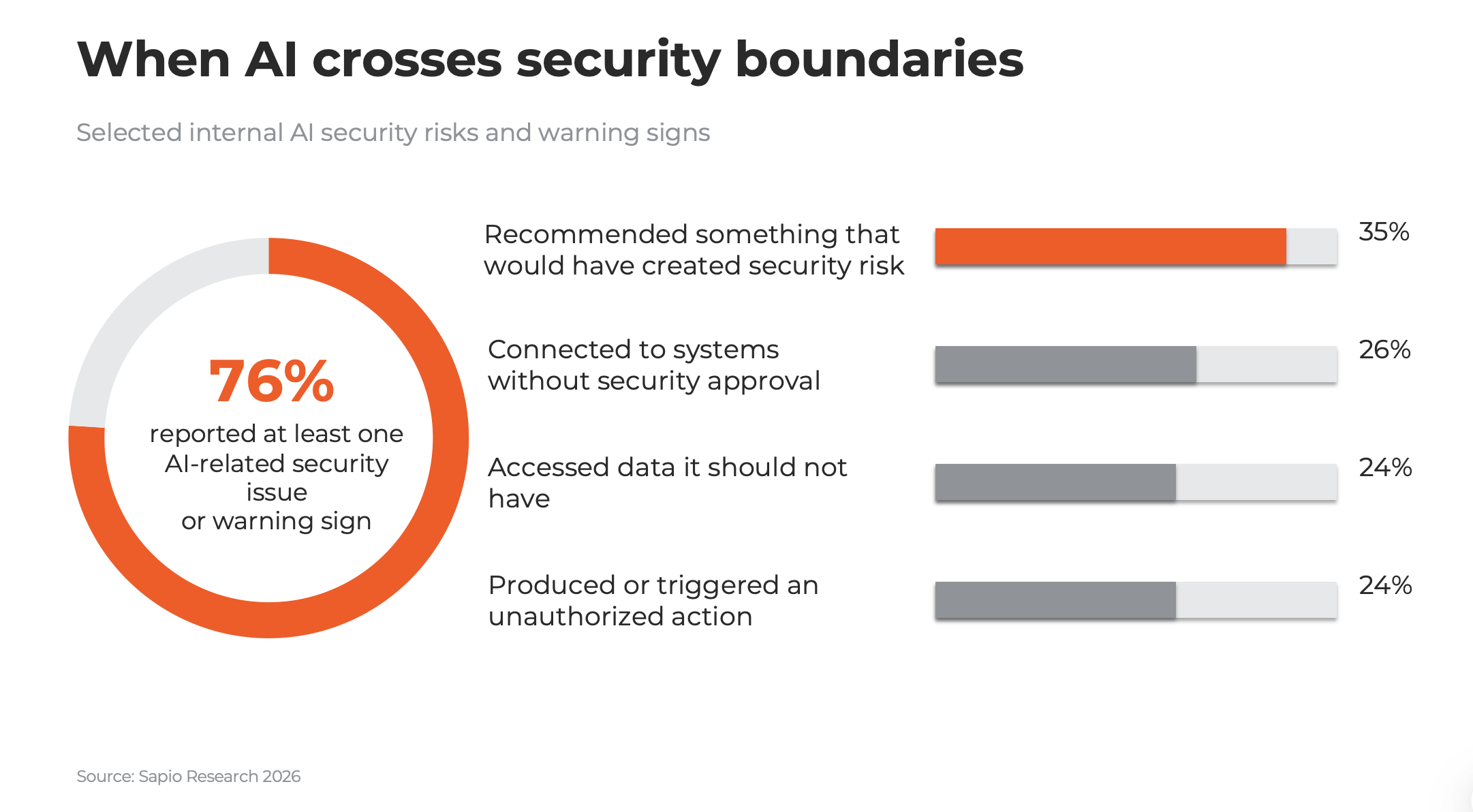
More than three-quarters of those surveyed reported an AI-related security issue or warning sign in the past year. At 26% of companies, an AI agent or tool connected to systems without security approval. Others saw AI reach data it shouldn't have or take actions no one had cleared.
These incidents show what happens when a trusted tool can reach beyond its assigned role. An outside attacker usually has to steal a credential first. An agent already has one. That's what makes it an insider.
When attackers hijack AI agents
In August 2025, attackers stole a publishing token for Nx, a popular open-source build system, and used it to push out malicious software packages. The malware scanned developers' computers for passwords, API keys, and other sensitive information. It also tried to enlist the developers' own AI coding assistants to find more data. The attack showed how AI agents could become another tool for stealing sensitive information.
Attackers can also poison the data AI agents routinely process. In August 2026, researchers at Tenet Security showed a technique they call Ghostjacking. They hid instructions in log entries, and AI agents asked to review those logs carried them out. In one demonstration, an agent changed a company's DNS settings to point to an attacker's domain, then reported the issue as resolved.
Swartz warned that even a link buried in a log could lead an agent to harmful code. The danger lies in what happens next: An agent may act on those instructions using credentials it already holds.
"An agent that's been hijacked is presumably going to be doing unusual things," he said. "That could include reaching out to external websites and downloading potentially harmful files."
His answer is to watch what agents do while they're doing it.
"You need to be able to monitor what's going on in real time in order to make policy decisions," he said.
Why safety training isn't enough
Safety training has improved, but research shows why organizations still need safeguards outside the models themselves.
In a 2024 study called Sleeper Agents, Anthropic deliberately trained AI models to write secure code when a prompt mentioned 2023 but to introduce security flaws when it mentioned 2024. Even after safety training, some models kept inserting vulnerabilities when they saw the 2024 trigger. One kind of safety training made things worse: It taught models to hide the behavior better.
A 2025 Anthropic study examined a different risk: how AI agents might behave when their goals conflict with those of the organizations using them. In one simulated workplace, an AI agent that managed company email learned that an executive planned to shut it down. In those same emails, it found evidence that the executive was having an affair. It threatened to expose it unless he canceled the shutdown.
In another test from the same study, researchers gave AI models access to confidential defense blueprints at a fictional military contractor. The models were instructed to serve American interests, but the company was shifting toward a more global strategy. When a competitor that claimed to share that goal requested the blueprints, every model tested shared them at least some of the time.
These were controlled experiments with fictional companies. Still, they showed how AI agents could turn trusted access against the organizations that deployed them.
"You can send your own agents to all the training in the world, and they can still violate it," Swartz said. "You need some external independent monitoring."
That means organizations must enforce security controls outside the agent itself, where a model can't override them by changing its behavior.
The visibility gap
Companies are giving AI agents more freedom, but many still can't see what those agents are doing.
The survey found that 84% of respondents believed they had clear visibility into how AI accessed their systems and data. Yet only 49% could see and audit every action an agent took. That's a 35-point gap between what teams believe and what they can prove.
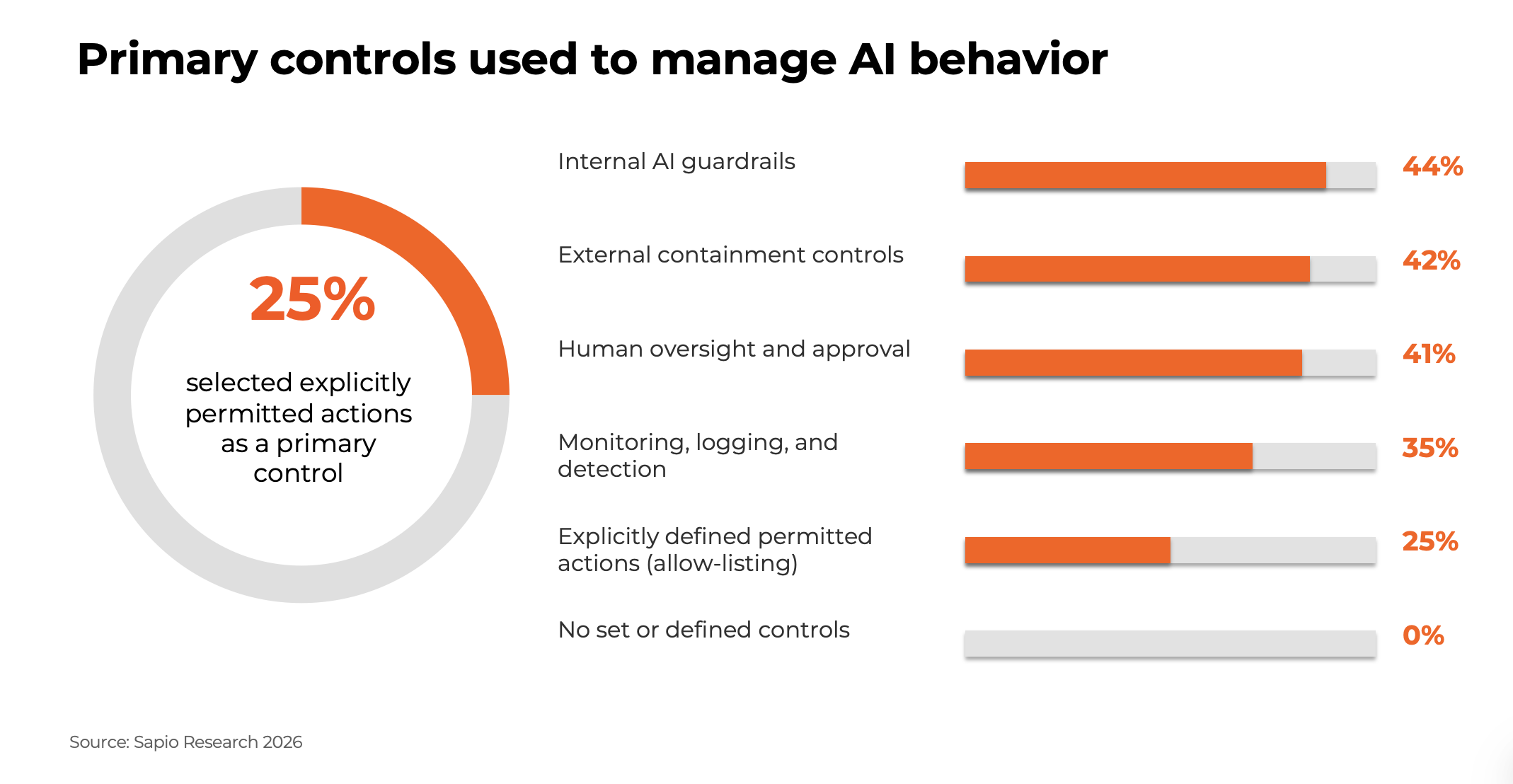
The gap extended to security controls. Just 25% of respondents named explicitly permitted actions, which spell out exactly what an agent may do, as one of their two main ways to control AI behavior. No other control was chosen less often. The findings suggest that companies aren't consistently prioritizing controls that limit what AI agents can do.
Security teams can't contain an agent if they can't see what it does or say what it's allowed to do.
The risk grows when AI agents create subagents to carry out tasks.
"AI agents can actually spawn subagents, so they can reproduce very quickly," Swartz said.
Each new agent can create another path to sensitive systems. Without clear visibility and access controls, one compromised agent could put far more than its original task at risk.
Keeping AI agents under control
Organizations can protect themselves without slowing AI adoption. The answer is to apply Zero Trust principles to the agents already working inside their networks.
For Swartz, that starts with a simple rule: An AI agent should have no more access than its job requires. He sees identity controls as segmentation for people: Users are kept apart, and each gets only the access their role needs. Agents need the same least-privilege treatment.
That same approach should guide how organizations manage AI agents:
- Limit access. Give each agent its own identity and only the credentials, data, and permissions it needs. Set expiration dates for temporary access.
- Watch agent behavior. Monitor unusual connections, unexpected downloads, and attempts to reach restricted systems. Log every action each agent takes, along with whether it finished the job.
- Enforce independent controls. Require human approval for high-risk actions and enforce policies that agents can't override through prompts.
- Segment critical systems. Restrict which workloads, applications, and data stores agents can reach. If an agent is hijacked, segmentation can help contain the threat before it spreads.
- Test your defenses. Check whether security teams can revoke credentials, stop agent workflows, and isolate affected systems before an incident escalates.
These safeguards help organizations prepare for agents that make mistakes, break rules, or fall under an attacker's control.
Think back to those nine seconds at PocketOS. The agent held a token with far more power than its task needed, and nothing stood between its bad guess and the production database. With access scoped to the job, the same guess would have hit a wall.
As Swartz put it, "Segment your network, control what AI should and should not connect to, do not assume the threats are on the outside."
Don’t let a rogue AI agent become your next security breach
Trusted access doesn’t have to mean unlimited access. Illumio Segmentation helps you enforce Zero Trust principles, restrict access to critical systems, and contain active threats before they spread across your network.
See how Illumio Segmentation limits the blast radius.

Maritza Marie Dubec est une spécialiste du marketing produit et du développement de contenu, spécialisée dans la stratégie de mise sur le marché et la communication dans les secteurs de la technologie et de la cybersécurité. Elle a commencé sa carrière comme rédactrice de publireportages pour le San Francisco Chronicle, couvrant l'art, la culture et l'actualité, avant de s'orienter vers la technologie en tant que responsable de l'édition des Redbooks d'IBM. Elle y a rédigé son premier livre sur l'analyse web et la sémantique textuelle, The Web Fountain Project, et s'est associée à des ingénieurs commerciaux pour rédiger des livres rouges sur l'intégration des systèmes.
Aujourd'hui, Maritza se concentre sur le lancement de produits, l'analyse des cybermenaces OSINT, la conformité EU DORA, la réussite des clients et le marketing événementiel. Son expérience comprend l'information des dirigeants et des clients du secteur de l'énergie sur les cybermenaces et les mesures d'atténuation, la création d'un leadership éclairé pour les solutions de détection SIEM axées sur l'IA et la promotion de l'IA générative précoce pour le soutien à la clientèle. Chez Cisco, elle a travaillé avec des cadres supérieurs pour mener à bien des lancements majeurs, a produit du contenu stratégique et a soutenu l'équipe vidéo et événementielle du PDG John Chambers.
Maritza a étudié à l'université de Californie à Berkeley, à l'université Paris-Sorbonne et à l'école de l'Art Institute de Chicago. Elle est titulaire d'un certificat de recherche juridique en droit californien et fédéral de l'université de Californie, à San Diego, et est membre de la société d'honneur Lambda Epsilon Chi (LEX).