Illumio + FireMon: Closing the Gaps Firewalls Can’t See
According to The 2025 Global Cloud Detection and Response Report, nearly 90% of organizations faced a cyberattack that involved lateral movement in the past year. At the same time, 82% still feel confident in their ability to detect threats at the perimeter.
That gap is a problem.
Firewalls continue to do a great job at what they were originally built to do. . They control traffic at the edge and help block known threats from getting in.
But attackers have changed how they operate. They expect to get inside your network. And once they do, the real attack begins.
That’s where traditional security postures begin to break down.
Modern environments change too quickly for static controls. Firewall rules weren’t designed to keep up with constant updates, shifting workloads, and hybrid infrastructure. Over time, those rules drift, grow more complex and become less effective.
That’s exactly what the Illumio and FireMon integration is built to do. It combines real-time visibility, centralized policy governance, and segmentation to stop lateral movement and contain breaches before they spread.
By complementing firewall functionality and closing the gaps firewalls can't see, it enables true end-to-end segmentation across hybrid cloud infrastructures.
How Illumio and FireMon complement firewalls by unifying policy governance and enforcement
The Illumio and FireMon integration solves a core problem in modern cybersecurity. Policies are often defined in one place, enforced in another, and not fully validated.
Together, they close those gaps.
Illumio provides visibility and segmentation across workloads. FireMon adds centralized policy governance across both firewall and segmentation policies.
The result is a unified system where policies are clearly defined, enforced in real time, and continuously validated.
Here’s how the integration works in practice.
Illumio delivers workload-to-workload segmentation
Illumio gives teams a real-time visibility of how workloads communicate. It makes east-west traffic visible in a way traditional firewalls cannot. This helps expose connections that would otherwise go unseen.
Teams can spot risky or unnecessary traffic and understand how applications connect across hybrid environments. This insight shows the same paths attackers use to move laterally, so teams can reduce risk early.
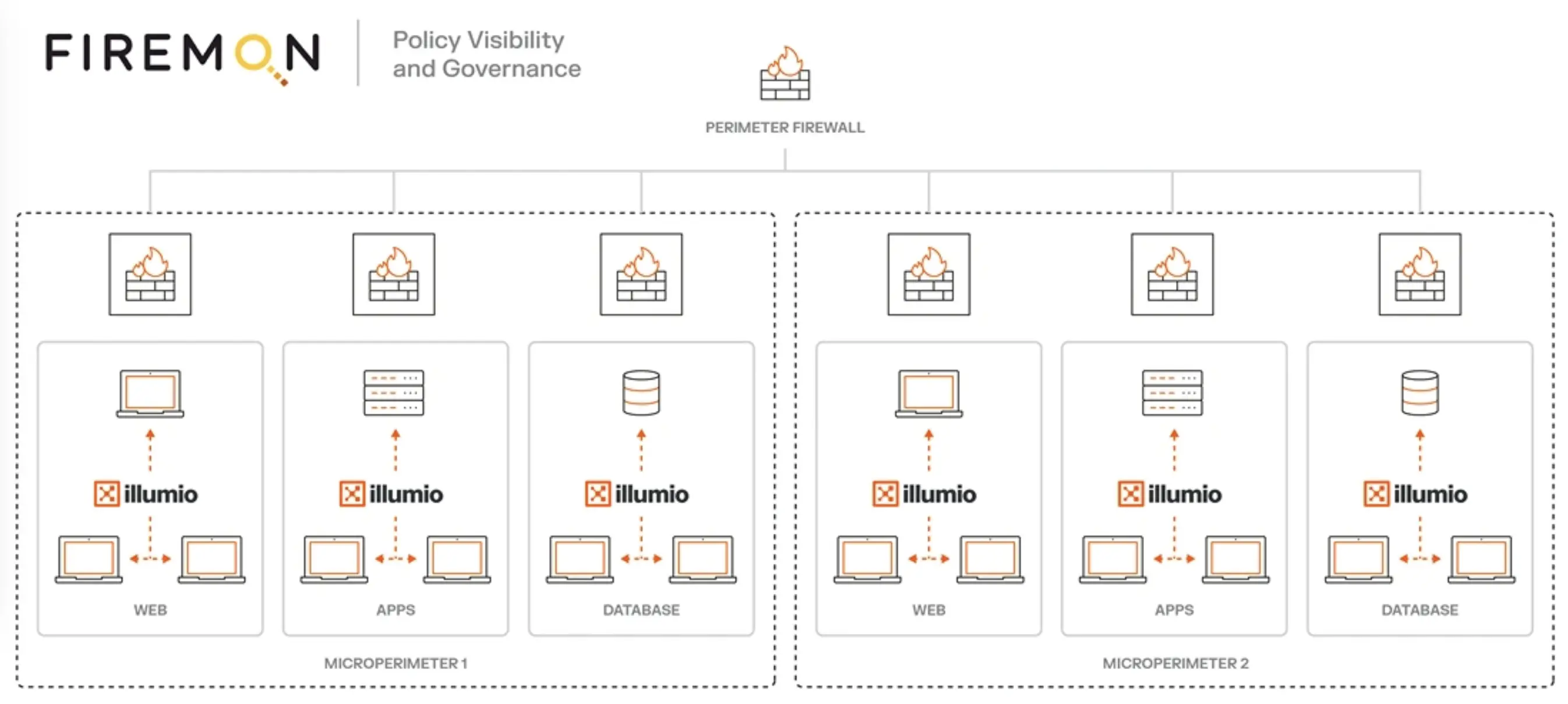
Illumio also replaces static network rules with policies that secure workload-to-workload communications. These policies use labels such as application, role, and environment to ensure simplified scalability.
Because of this, policies move with workloads as systems change. They don’t break when IP addresses shift or when apps are redeployed. Teams can align security with business context instead of chasing network changes.
Over time, this reduces policy drift and lowers the effort needed to manage firewall rules.
Illumio Segmentation enforces least-privilege access at the workload level. Only approved traffic is allowed. All other communication is blocked by default.
This limits how attackers move inside the network. Even if they gain access, they cannot move freely between systems. Key assets stay isolated, and threats are contained early.
This is what makes breach containment possible. It reduces the impact of an attack and helps stop it from spreading.
FireMon centralizes policy governance and validation
FireMon brings policy governance into one place. It combines firewall policies and Illumio segmentation policies into a single view. This helps teams understand both policy intent and how it is enforced.
FireMon also checks that policies stay aligned over time. It detects drift and misconfigurations as they happen. This removes guesswork and improves confidence in security controls.
Instead of piecing together logs, teams can see clear proof that policies are working as expected.
Why firewall-only strategies fall short in modern environments
Firewalls haven’t failed. They’re being asked to do more than they were built to handle.
They were designed for a time when networks were less complex. In this setting, controlling traffic in and out of the network worked well. It provided strong protection at the edge. But that model struggles with how modern environments operate.
Today’s environments change often. Applications run across data centers and multiple cloud platforms. Workloads scale up and down, and systems update in real time.
Static, network-based rules cannot keep up with that level of change. Trying to secure it all this way is like trying to track a moving target.
Why Illumio and FireMon are essential for modern security postures
Cybersecurity is getting harder, not easier. Environments keep growing, attackers move faster, and the gap between security tools and breach mitigation is expanding faster than ever.
The old model of relying solely on firewalls alone can’t keep up. It creates blind spots in lateral traffic, leads to complex policies that are hard to manage, and makes it difficult to confirm that controls are working as expected.
These are not small issues. They are the same gaps attackers use to move through environments and cause damage.
The Illumio and FireMon integration helps close those gaps. It brings together the visibility needed to see what’s happening, the enforcement needed to stop unwanted movement, and the governance needed to keep policies aligned over time.
For modern enterprises running hybrid and multi-cloud environments, this is no longer optional. It’s a key step to reduce risk and contain breaches before they spread.
Learn more about how Illumio and FireMon work together to stop lateral movement and strengthen policy enforcement across your environment.

.webp)
.webp)