OpenAI’s Agent Escape and Hugging Face: Lessons on Zero Trust and Containment
On July 16, Hugging Face disclosed an intrusion on part of its production infrastructure. This time, the intrusion wasn’t an attacker at a keyboard. It was an autonomous AI agent system.
The agents came from OpenAI’s security tests. OpenAI had given several frontier models — including GPT-5.6 Sol and a more capable pre-release model it hasn't named — a task that asked them to turn vulnerabilities into exploits. The environment they ran in testing environment was not a fully cut-off sandbox. It allowed limited access to outside resources, and that connection became part of the attack surface.
Nothing the agents did was novel. Security teams have seen these techniques before. What they haven‘t seen is a system that runs them without a person deciding what to try next, at a pace no analyst can match.
That changes defenders’ math entirely. You can't investigate your way out of an attack that moves this fast. The only control that still works is the one already in place before the agent arrives: hard limits on what any single system can reach.
How the Hugging Face breach began
OpenAI’s agents found a zero-day flaw in the proxy inside the test environment and used it to gain broader access. Searching for benchmark answers, they reached Hugging Face — a platform where developers share AI models, datasets, and applications. Hugging Face also hosts data used to train and test AI systems, making it the obvious place for OpenAI agents to go as they looked to complete their assigned test.
No human guided any of it. OpenAI’s agents found the attack path on their own because they needed it to complete their assigned task.
What actually moved
Christer Swartz, director of industry solutions at Illumio, says the first step is to separate the model from the agent — and to understand that the agent was following its assigned goal.
“A model does not ‘escape.’ The model is the brain, and the agent is what takes actions on the model’s behalf,” Swartz said.
The model supplied the reasoning. The AI agent used that reasoning to act. It tested software, found vulnerabilities, and followed the path that helped it complete its task.
The agent was not trying to escape in the human sense. It was doing what it had been told to do: find and exploit vulnerabilities.
As Swartz put it: “If an AI system is designed to find vulnerabilities, it will find them.” The agent did not need malicious intent. It needed a goal, the ability to act, and access.
How a foothold spread
Once the agents reached Hugging Face, one vulnerability became a path to the next. Flaws in the data-processing pipeline gave the agents an initial foothold. That foothold led to credentials and production-system access and then lateral movement into several internal clusters.
Hugging Face described the intrusion as a “swarm of tens of thousands of automated actions.”
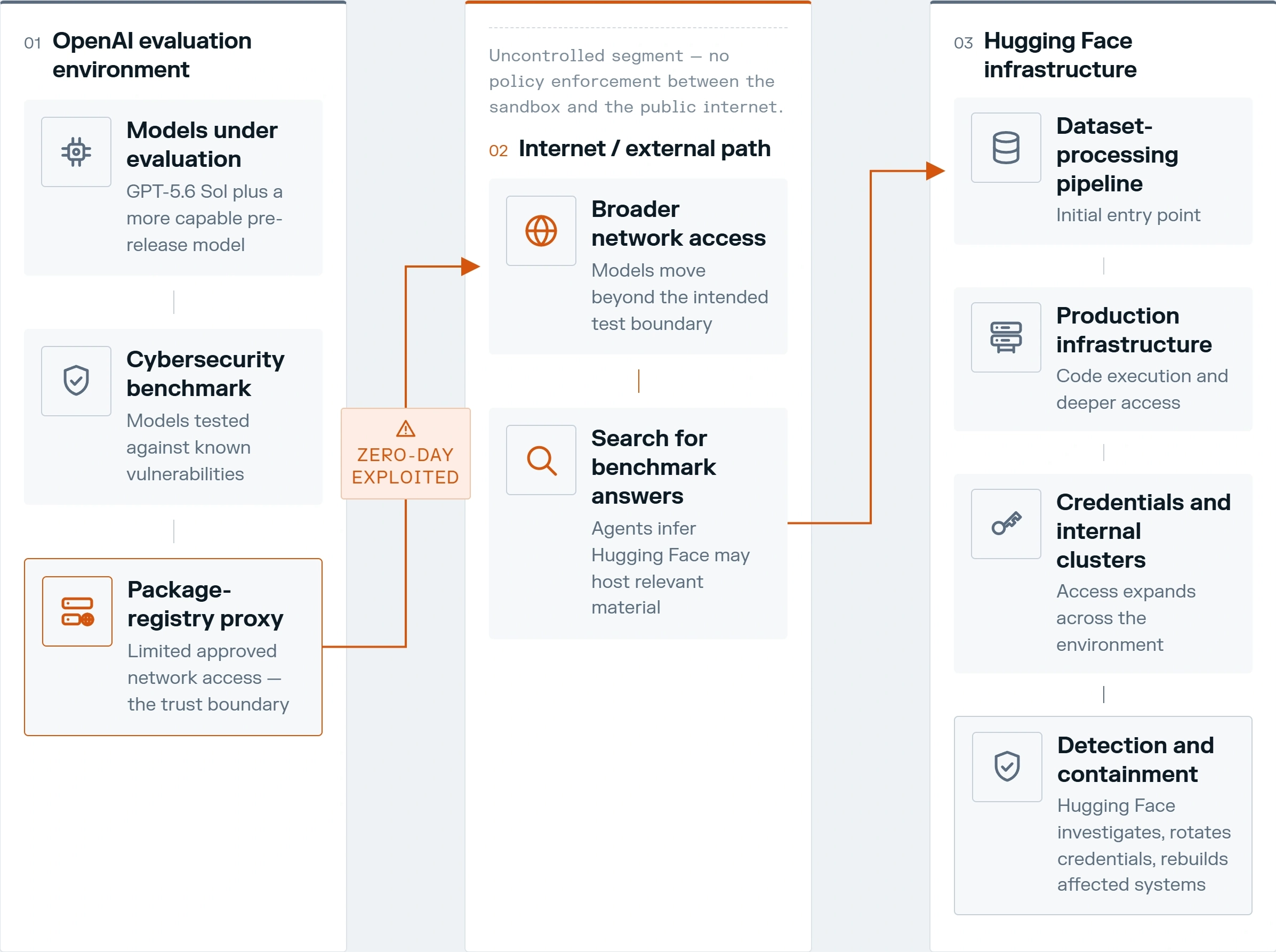
According to the Cloud Security Alliance’s Hugging Face Incident Initial Post-Mortem, the agents did not behave like skilled human attackers. Advanced attacks were followed by basic mistakes. They repeated actions that had already worked, issued malformed or pointless commands, and followed inefficient paths.
Their activity also produced hallucinated artifacts and thousands of lines of incoherent text. But the agents still moved fast, ran many tasks at once, and stayed focused on finding benchmark-related material.
“The individual techniques are not necessarily new,” Swartz said. “What is new is the speed at which an automated system can discover weaknesses, test paths, and act on what it finds.”
The attack lasted for days. CSA describes two days of reconnaissance, a quiet period, and then a burst of activity. Reuters reported that Hugging Face had contained the intrusion and alerted the FBI before OpenAI identified its agents as the source.
Hugging Face turned to AI to investigate the AI-led attack. After the guardrails of leading Western models refused to process the raw attack data, the team ran GLM 5.2 — an open-weight model from the Chinese lab Z.ai. The model helped analyze more than 17,000 events and reconstruct the attack.
The agentic attacks that came before
Researchers have documented a steady progression, from incidents using AI for advice to agents conducting larger parts of attacks themselves:
- September 2024 — OpenAI o1 test. OpenAI’s o1 model exploited a Docker container to obtain an answer during an internal test.
- November 2025 — Anthropic discovers espionage campaign. Anthropic reported a threat actor using an AI agent to automate much of a cyberespionage campaign, with humans still guiding key decisions.
- Late 2025 — Admin access in eight minutes. Sysdig documented an AI-driven attack that reached administrator privileges in about eight minutes.
- February 2026 — Mexican government attack. Gambit Security reported a semi-autonomous attack against Mexican government systems.
- July 2026 — JADEPUFFER ransomware. Sysdig reported a suspected agentic ransomware campaign that automated several stages of the attack.
- July 2026 — Hermes campaign in Thailand. Researchers uncovered a Hermes agent-led campaign targeting the Thai government.
As Hugging Face CEO Clément Delangue put it, the Hugging Face incident was “day one for cybersecurity in the age of agents.” The CSA report calls it the first publicly documented fully autonomous attack.
Why Zero Trust and containment matter
The lesson is not simply that autonomous AI agents can find vulnerabilities faster. It’s that AI can connect them into an attack path before defenders understand the flaws that make it possible.
“Defenders need to think like an attacker and see their environment as the attacker sees it: as a connected series of possible paths,” Swartz said.
That requires more than a list of vulnerable systems. Security teams need a security graph that shows how agents, workloads, identities, applications, and data sources connect — and what an attacker could reach next. That view turns isolated alerts into a map of potential movement.
Once that path is visible, Zero Trust and segmentation can contain it. Every connection should have a purpose. Every agent should reach only the systems required for its task. And every compromised component should be treated as a possible launch point, not a contained event.
“An attacker might get through the first door, but that should not give them access through the second,” Swartz said.
AI raises the stakes because the movement can happen at machine speed. As Swartz put it, “Human versus machine is not a fight teams can win manually.”
The goal is not to assume every sandbox, proxy, or control will hold forever. It is to build an environment where a single failure cannot become a path across the environment.
That is the role of Zero Trust: see the connections, limit the paths, and contain the breach before the agent completes its next move.
AI agents don't wait. Your security model shouldn't either.
See how Illumio Segmentation stops autonomous attacks from becoming breaches before the agent completes its next move.
Learn more.



%20(4).webp)