Introducing Network Posture: Your Security Posture, Graded by Real Traffic
Every security team has a document that says how the network should behave: firewall rules, access policies, segmentation designs, and control mappings for the frameworks you report against.
But almost no team has a way to check that document against what the network is doing in real time.
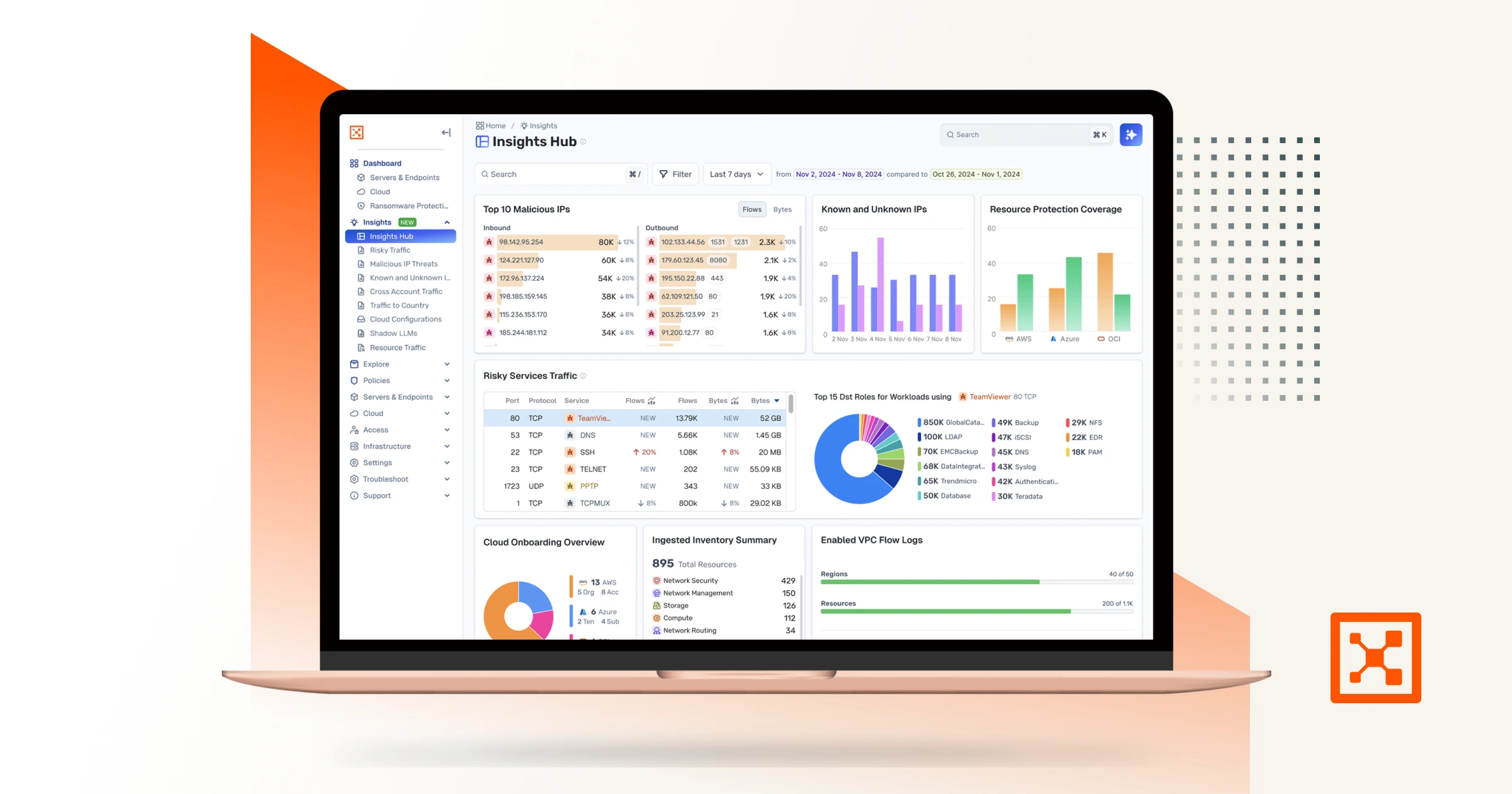
That’s why we’re excited to unveil Network Posture. It’s a powerful new feature inside Illumio Insights that continuously grades real network activity against your controls and compliance requirements and returns a live score and a ranked list of your riskiest violations.
Your posture stops being a claim you assemble for an audit and becomes a measurement you can take any day, from evidence the network produces itself.
.webp)
Why static audits miss your real network security posture
Most compliance and posture tools are declarative. They grade configured rules against a standard. That tells you what you meant to do rather than what your network is doing. The gap is where risk lives.
A firewall rule can be correct on paper while a forgotten jump host bridges two environments. A policy can pass an audit while a contractor’s remote access session runs wide open.
Network Posture grades observed flows instead of stored configurations, so it catches what a config review can’t: unauthorized remote access, shadow IT, and traffic that violates your own guardrails.
Answering the most critical security questions in one place
Ask most security teams a few basic questions, and they’ll struggle to answer:
- Are our critical systems exposed to the internet?
- Are we compliant with the frameworks we report against?
- Which violations carry the most risk, and what should we fix first?
The information usually exists. It’s just scattered across a dozen tools, each with its own alert queue and its own idea of what counts as a finding.
Network Posture builds one view. It scores what your network actually does against compliance standards and custom guardrails, tracks how that score moves, and surfaces the exposures, violations, and overly permissive access that matter most.
Cybersecurity compliance measured against live traffic
Network Posture grades observed behavior against the standards and regulations you’re accountable to: PCI DSS, DORA, GDPR, SOC 2, CIS, and NIST CSF, plus IoT and OT frameworks like IEC 62443 and NIST SP 800-82.
You get posture scores, compliance findings, and a record of how your posture has improved. That makes it easier to prove you’re audit ready and decide what to tackle next.
Find the attack paths before an attacker does
Network Posture also maps the routes an attacker could take between applications, systems, and environments. It compares real communication patterns against your controls and application dependencies.
You can spot over-permissive access, vulnerable assets on live pathways, and where lateral movement would go if a breach started tomorrow. From there, you can shrink those paths before anyone exploits them.
Security posture management that ends in enforcement
Finding risk is the easy half of the problem. Network Posture closes the other half.
Violations arrive sorted by criticality, so teams see what carries the most weight. Each one comes with a direct path to a segmentation policy that shuts the gap.
Remediation happens in the same console, on thenext click.
Teams use Network Posture to find internet-exposed assets, measure exposure tied to critical vulnerabilities, and set a baseline before they deploy segmentation. For teams already running it, Network Posture confirms controls still work as environments change.
The fast button to microsegmentation
For most organizations, the hard part of microsegmentation is knowing where to start and when it’s working.
Network Posture answers both. It turns live flows into a ready-made action plan and surfaces your highest-risk exposures first so teams can aim segmentation where it reduces the most risk.
From there it runs as a continuous improvement engine: find the biggest gap, close it, prove it closed, move on. That’s how Network Posture moves customers along their Zero Trust journey with evidence at every step.
Why continuous posture validation can’t wait
Networks don’t hold still anymore. Workloads move between clouds weekly, applications pick up dependencies nobody documents, and AI agents open connections at machine speed.
Every one of those changes is a new path across your environment, so last quarter’s posture assessment describes a network that no longer exists.
Attackers work in that gap. They take the same over-permissive paths a configuration review never surfaces, and those paths open faster than a review cycle can catch them.
Regulators have noticed. DORA and PCI DSS 4.0 push teams to treat controls as something you operate and prove continuously, not certify once a year.
Whether you’re preparing for an audit, cutting attack surface, governing multi-cloud, or advancing Zero Trust, Network Posture gives you continuous proof that your network enforces the policy you wrote.
That’s what breach containment looks like in practice, and it’s how teams build durable cyber resilience across hybrid environments.
Ready to see your network security posture in real time? Try Network Posture in your Illumio Insights free trial today.